🛡️ Protect Python Code
ℹ Introduction
Python scripts can be protected in order to avoid the theft of intellectual property, algorithms, or anything else you want to hide from the final user. When using an interpreter (usually CPython), your code is translated from human-readable Python into Python bytecode (stored in __pycache__) on the user's computer. With some modifications to the CPython source code, one could extract all the code, even if it is obfuscated, without much difficulty. The solution provided here works only on Windows, but you could use Wine on Linux to run the binaries.
How to dump code object to disk ?
Compile Python from the source. Modify the _PyEval_EvalFrameDefault function such that it dumps the code object to disk.
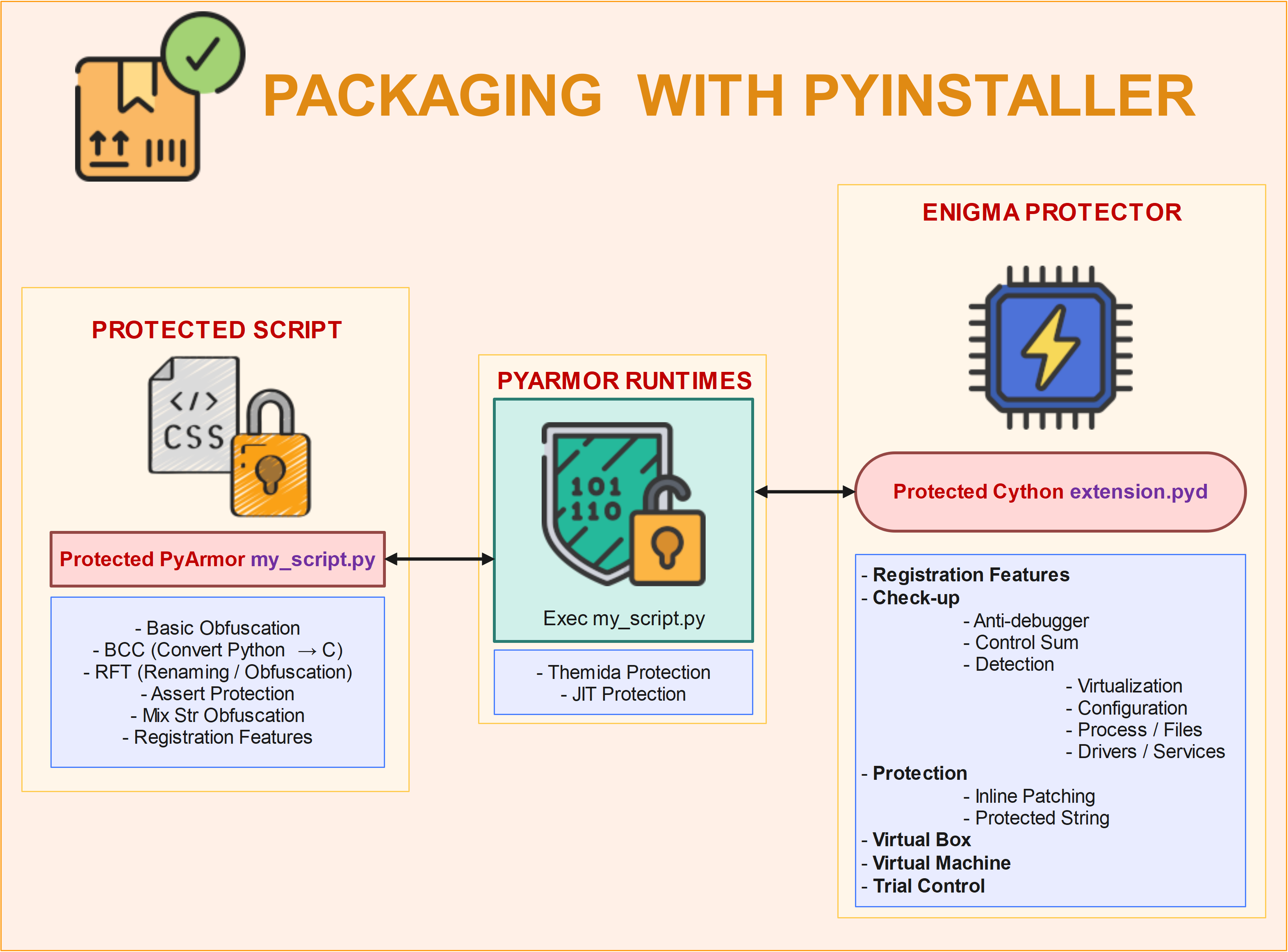
In this note, I propose a strong way of protecting your Python scripts. The Python script will be obfuscated by a tool named PyArmor, which relies on an external, closed-source library. The essential algorithms/functions will be translated into C++ by Cython, which will provide a Dynamic Link Library. This library will be protected by Enigma Protector and called by our Python script. The whole program will be packed with PyInstaller.
🔧 Requirements
- Enigma Protector - 200 €
In order to compile, you need to move two files into your project from the
sdk/VCpath of Enigma Protector. File 1:enigma_ide.hFile 2:enigma_ide64.lib
In enigma_ide.h, just insert the following line.
- PyArmor - 100 €
- Cython with MSVC
- PyInstaller
- UPX
⚙️ Process

🔨 Building protected extension.pyd
🏎️ Cython testing
About Cython
Cython is a programming language that aims to be a superset of the Python programming language, designed to give C-like performance with code that is written mostly in Python with optional additional C-inspired syntax. Cython is a compiled language that is typically used to generate CPython extension modules.
Cython can generate a C++ file from your Python code. This file can then be compiled into a dynamic link library (DLL), which can be called directly by your Python code.
The first file is the Python script you want to convert to C. Please note the .pyx extension.
File: fib.pyx
# cython: language_level=3
def fib(n):
    """Print the Fibonacci series up to n."""
    a, b = 0, 1
    while b < n:
        print(b, end=' ')
        a, b = b, a + b
    print()
Now we need to create the setup.py, which is a Python build script (for more information,
see Source Files and Compilation
File: setup.py
from setuptools import setup
from Cython.Build import cythonize

setup(
    ext_modules=cythonize("fib.pyx"),
)
Run the following command:
It converts the file to C and compiles it with MSVC into fib.cp311-win_amd64.pyd.
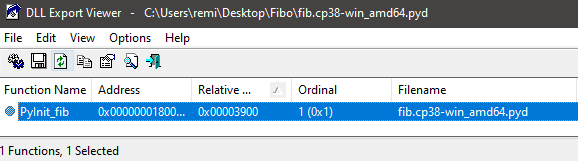
DLL Export Viewer tells us this is a valid DLL
🔮 Enigma Protector
The goal is to protect your Python app, and especially here your .pyd extension with Enigma Protector. In order to do this, you will need:
- some of your most important code in a
.pyxfile, which will be converted toC++; this code will be protected; - protect the DLL produced by Cython with Enigma Protector;
- Use it !
Important
C-compiled files are faster than Python because they do not deal with Python object structures. C files are also faster when they deal with loops, and because they do not deal with the GIL, Cython gives you the opportunity to use all your CPU cores.
Warning
Be careful: the GIL exists to avoid some complex problems with memory access to shared variables and to handle the garbage collector correctly.
⚒ Tuning before compilation
Here we are working with a C++ file. It doesn't change a lot, except in setup.py.
File: setup.py
from setuptools import setup, Extension
from Cython.Distutils import build_ext

setup(
    name='Test app',
    ext_modules=[
        Extension('test_it',
                  sources=['script_test.pyx'],
                  extra_link_args=['/MAP'],
                  libraries=["enigma_ide64"],
                  language="c++")
    ],
    cmdclass={'build_ext': build_ext}
)
👓 API Studying
I will not copy the whole manual in this article. If you want more information about the API, please read the manual.
A Marker is a set of bytes placed into the source code and helping Enigma Protector find the code inside markers for processing. A marker consists of two parts: begin marker and end marker.
EP_RegHardware function serves for retrieving unique user PC information. The function does not have parameters. If the function succeeds, the return value is a pointer to the null-terminated ANSI string. If the function fails, the return value is 0.
// Registration API
__declspec(dllimport) char* __stdcall EP_RegHardwareID();
__declspec(dllimport) wchar_t* __stdcall EP_RegHardwareIDW();
EP_RegKeyStatus EP_RegKeyStatus returns the error status of registration information after the key verification routine. It should be called after any function that verifies registration information, for example, after EP_RegCheckKey or EP_RegLoadAndCheckKey.
EP_RegCheckAndSaveKeyW function serves for verifying and saving the registration information. It has the same functionality as EP_RegCheckAndSaveKey, but is used for processing Unicode (wide) strings data. Please note, to use this function you should enable UNICODE Registration Scheme at REGISTRATION FEATURES - Common panel.
__declspec(dllimport) BOOL __stdcall EP_RegCheckAndSaveKeyW( const wchar_t* Name, const wchar_t* Key );
EP_RegDeleteKey function serves for deleting the existing registration information.
EP_ProtectedString function returns protected strings. See also Protection Features - Protected Strings.
__declspec(dllimport) int __stdcall EP_ProtectedStringByID( int ID, const char* Str, int Len);
__declspec(dllimport) int __stdcall EP_ProtectedStringByKey( const char* Key, const char* Str, int Len);
🎇 Using Widestring Char (Unicode) in Cython - wchar_t*
Because the API exposes two kinds of functions, one AnsiString and one WideString, please consider the following code to work with WideString.
# Imports and declaration to work from WideChar
from cpython.ref cimport PyObject
from libc.stddef cimport wchar_t

cdef extern from "Python.h":
    PyObject * PyUnicode_FromWideChar(wchar_t *w, Py_ssize_t size)

# import functions
cdef extern from "enigma_ide.h":
    void EP_Marker(char* Name)
    char* EP_RegHardwareID()
    wchar_t * EP_RegHardwareIDW()

cdef PyObject * pystr = PyUnicode_FromWideChar(EP_RegHardwareIDW(), -1)
wide_str_hid = str(<object> pystr)
print('WideChar :', wide_str_hid)
🗜️RISC Markers Virtualization
File: script_test.pyx
# distutils: language = c++
# cython: language_level=3
# import functions
cdef extern from "enigma_ide.h":
    void EP_Marker(char* Name)

# Declare a trivial function
def sum_it(number1, number2):
    return number1 + number2

# Protect this with RISC virtualization
EP_Marker("vm_risc_begin")
a = 4
b = 7
c = a + b
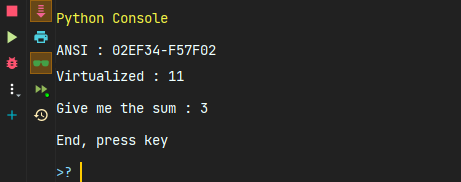
print('Virtualized :', c)
EP_Marker("vm_risc_end")

# Classic Python code
print("Give me the sum :", sum_it(1, 2))
input("End, press key")
MSVC.
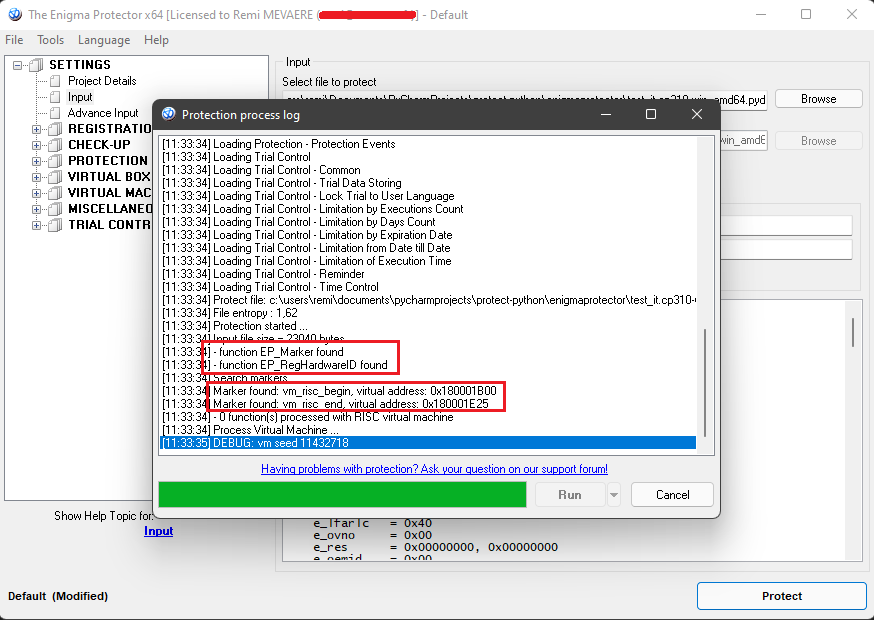
The protected module and its functions are callable like any other module in Python. So in our program, we will load this extension.pyd like any other package/module.
Example: importing test_it will run the module initialization code.
🗜️ Choose function to virtualize
- Need
extra_link_args=['/MAP']insetup.py - Virtual Machine → Functions Selecting → Add Functions
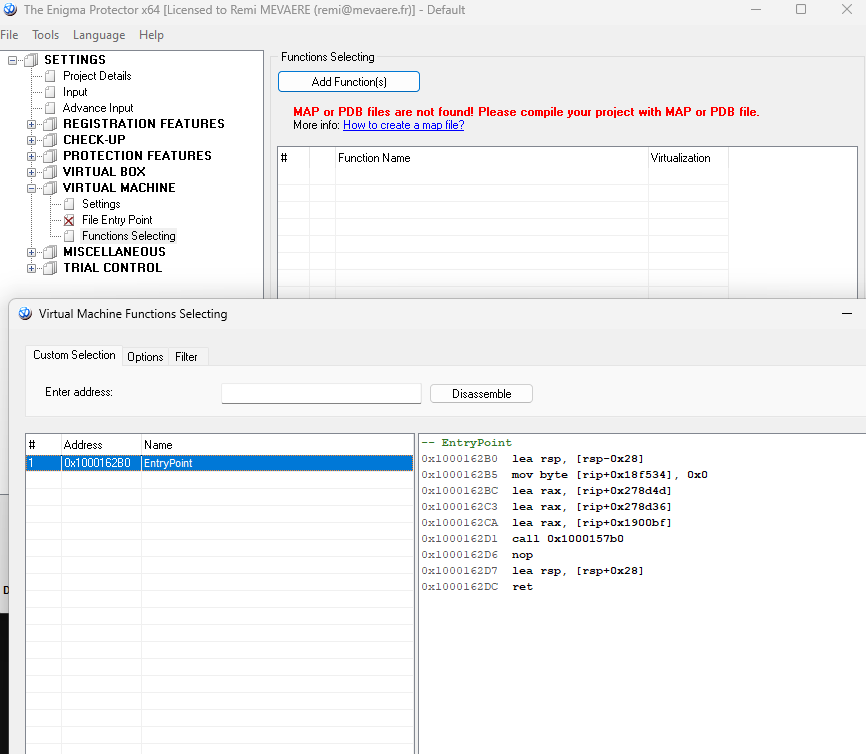
In order for a function to be visible in Enigma Protector, it’s important to mark the function public.
cpdef public int ma_fonction_A(int number1, int number2):
    print("Welcome in function A")
    cdef int number3
    number3 = int(input("Give me a number :"))
    return number1 + number2 + number3
🔏 Registration feature
🖲️Get Hardware ID
# distutils: language = c++
# cython: language_level=3

import cython
from cpython.ref cimport PyObject
from libc.stddef cimport wchar_t

cdef extern from "Python.h":
    PyObject * PyUnicode_FromWideChar(wchar_t *w, Py_ssize_t size)
    wchar_t * PyUnicode_AsWideCharString(object, Py_ssize_t *)

cdef extern from "enigma_ide.h":
    char * EP_RegHardwareID()
    wchar_t * EP_RegHardwareIDW()

# ANSI
ansi_str_hid = str(EP_RegHardwareID(), 'cp1252')
print('EP_RegHardwareID :', ansi_str_hid)

# WIDE
cdef PyObject * pystr
pystr = PyUnicode_FromWideChar(EP_RegHardwareIDW(), -1)
wide_str_hid = str(<object> pystr)
print('EP_RegHardwareWide :', wide_str_hid)
🔓 Register software
First, you need to generate a key. Please note that in this article I will use WideChar (Unicode in configuration). It is more complex than ANSI; if you understand it with Unicode, it will be straightforward with ANSI.
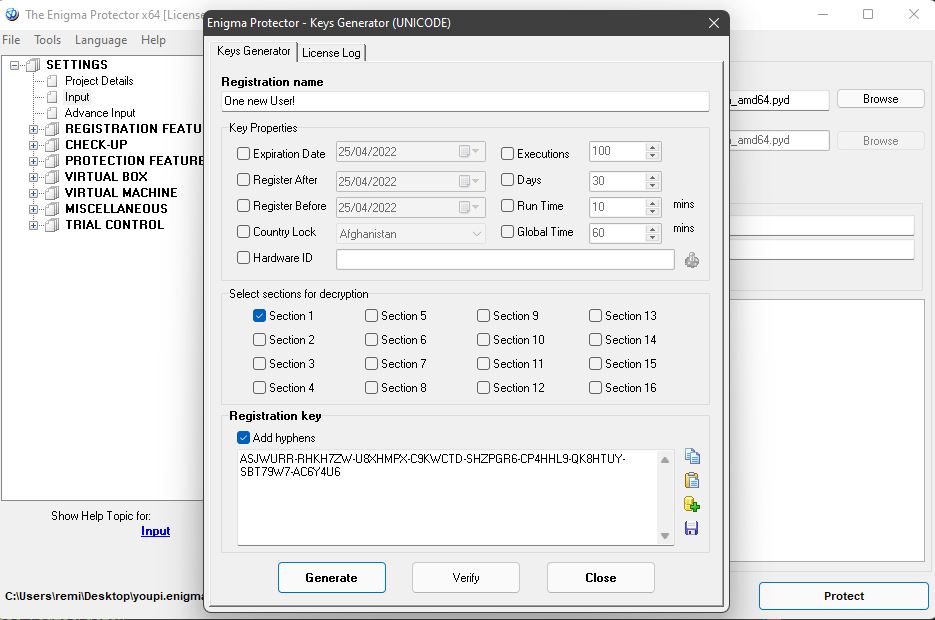
# distutils: language = c++
# cython: language_level=3

import cython
from cpython.ref cimport PyObject
from libc.stddef cimport wchar_t
from libcpp cimport bool

cdef extern from "Python.h":
    PyObject * PyUnicode_FromWideChar(wchar_t *w, Py_ssize_t size)
    wchar_t * PyUnicode_AsWideCharString(object, Py_ssize_t *)

cdef extern from "enigma_ide.h":
    bool EP_RegCheckAndSaveKeyW(wchar_t * Name, wchar_t * Key)

reg_name = input("Name :")
reg_key = input("Key :")

cdef wchar_t *reg_name_wchar
cdef wchar_t *reg_key_wchar
cdef Py_ssize_t length

reg_name = u"Test-WrongUSER"
reg_key = u"CKML369-XGSH5DW-RVG2ANU-W4FG4K4-J2RQYHM-32SD3LD-XJPKSYB-S5RPPPE-SEURZXQ"

reg_name_wchar = PyUnicode_AsWideCharString(reg_name, &length)
reg_key_wchar = PyUnicode_AsWideCharString(reg_key, &length)

print("Registration to : ", reg_name)
if EP_RegCheckAndSaveKeyW(reg_name_wchar, reg_key_wchar):
    print("Registration OK, please restart APP")
    quit()
else:
    print("Registration ERROR")
🪟 Registration dialog
If you want to use the registration dialog, just use the dedicated API.
🪄 Registration status
# distutils: language = c++
# cython: language_level=3

import cython
from cpython.ref cimport PyObject
from libc.stddef cimport wchar_t

cdef extern from "enigma_ide.h":
    int EP_RegKeyStatus()

if EP_RegKeyStatus() == 1:
    print("You are registered")
else:
    print("You are NOT registered")
🔐 Locking function from registration
# distutils: language = c++
# cython: language_level=3

import cython

cdef extern from "enigma_ide.h":
    void EP_Marker(char * Name)

cdef public int ma_fonction_B(int number1, int number2):
    cdef int number3

    # If the user is registered and the key allows block 6
    EP_Marker("reg_crypt_begin6")
    print("Welcome to the registered and crypted part 6")
    number3 = int(input("Give me a number :"))
    EP_Marker("reg_crypt_end6")

    # If the user is not registered or doesn't allow block 6
    EP_Marker("unreg_crypt_begin6")
    print("Welcome to the unregistered part 6")
    number3 = 8
    EP_Marker("unreg_crypt_end6")
    return number1 - number2 - number3
❌ Delete registration
# distutils: language = c++
# cython: language_level=3

import cython
from libcpp cimport bool

cdef extern from "enigma_ide.h":
    bool EP_RegDeleteKey()

if EP_RegDeleteKey() == 1:
    print("Deletion of registration OK")
🗃️ File virtualization
It is possible to hide some files inside the executable. You will access these files directly from your script.
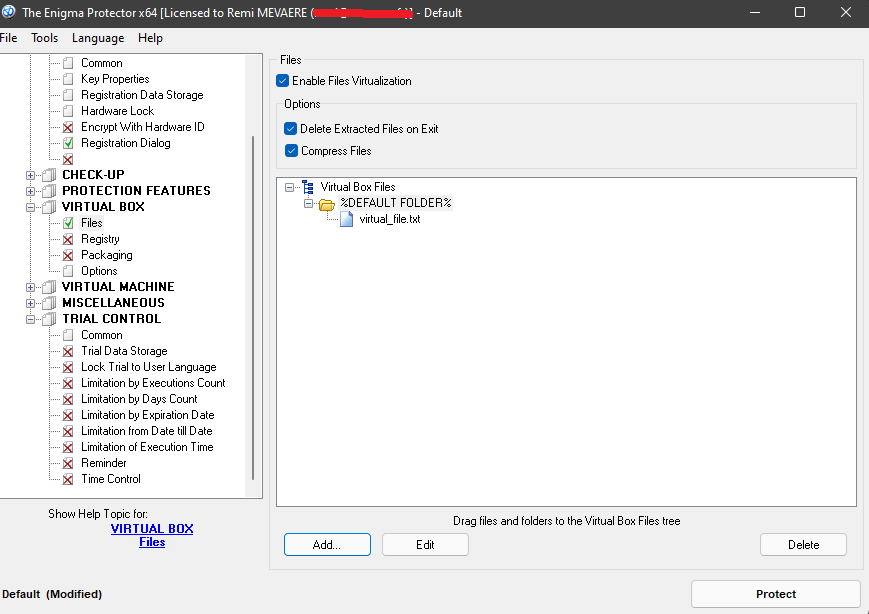
Add a file virtual_file.txt with some text
You could read the file with Python easily:
with open('virtual_file.txt') as f:
    lines = f.readlines()

print("------- virtual_file.txt -------")
print(lines)
print("--------------------------------")
🧵 Protected strings
You can add some sensitive protected strings in your code. We will see in this section how to retrieve them:
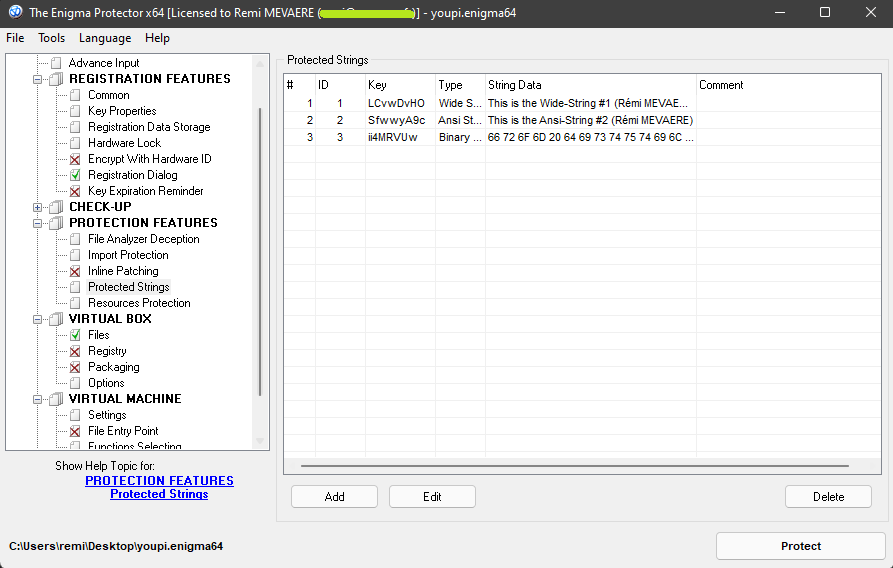
Add some strings in Enigma Protector
🧶 ANSI string
ID
import cython
from libc.stdlib cimport malloc, free
from cpython.bytes cimport PyBytes_FromStringAndSize

cdef extern from "enigma_ide.h":
    int EP_ProtectedStringByID(int ID, char * Buffer, int Len)

cdef char * buf_string_2
buf_size_2 = EP_ProtectedStringByID(2, b'', 0)
print("Size of the string #2: ", buf_size_2)
buf_string_2 = <char *> malloc((buf_size_2) * sizeof(char))
if EP_ProtectedStringByID(2, buf_string_2, buf_size_2) != 0:

    py_bytes = PyBytes_FromStringAndSize(<char *> buf_string_2, buf_size_2)
    ansi_string = py_bytes.decode('windows-1252')
    print('AnsiString :', ansi_string)
else:
    print("Error can't extract #2")

free(buf_string_2)
Key
import cython
from libc.stdlib cimport malloc, free

cdef extern from "enigma_ide.h":
    int EP_ProtectedStringByKey(char * Key, char * Left, int Len)

cdef char * buf_string_2

buf_size = EP_ProtectedStringByKey("tckQpD9z", b'', 0)
print("Size of the string #1: ", buf_size)
buf_string_2 = <char *> malloc((buf_size + 1) * sizeof(char))
if EP_ProtectedStringByKey("tckQpD9z", buf_string_2, buf_size) != 0:
    buf_string_2[buf_size] = b'\0'
    print(str(buf_string_2, 'cp1252'))
else:
    print("Error can't extract #1")
free(buf_string_2)
🪢 Widestring
import cython

from cpython.ref cimport PyObject
from libc.stddef cimport wchar_t
from libc.stdlib cimport malloc, free
from cpython.bytes cimport PyBytes_FromStringAndSize

cdef extern from "enigma_ide.h":
    int EP_ProtectedStringByID(int ID, char * Buffer, int Len)

buf_size = EP_ProtectedStringByID(1, b'', 0)
print("Size of the string #1: ", buf_size)

cdef wchar_t * buf_string
if buf_size > 0:
    buf_string = <wchar_t *> malloc(buf_size)
    if not buf_string:
        raise MemoryError("Failed to allocate memory")
    EP_ProtectedStringByID(1, <char *> buf_string, buf_size)

    py_bytes = PyBytes_FromStringAndSize(<char *>buf_string, buf_size)
    wide_string = py_bytes.decode('utf-16')
    print('WideString :', wide_string)
free(buf_string)
💾 Binary
import cython

from cpython.ref cimport PyObject
from libc.stdlib cimport malloc, free

cdef extern from "enigma_ide.h":
    int EP_ProtectedStringByKey(char * Key, char * Left, int Len)

cdef char * buf_string_2

buf_size = EP_ProtectedStringByID(3, b'', 0)
print("Size of the string #3: ", buf_size)

buf_string_2 = <char *> malloc((buf_size + 1) * sizeof(char))

if EP_ProtectedStringByID(3, buf_string_2, buf_size) != 0:
    print(str(buf_string_2))
else:
    print("Error can't extract #3")
free(buf_string_2)
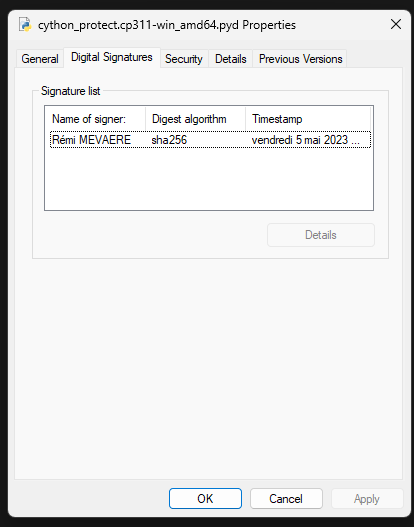
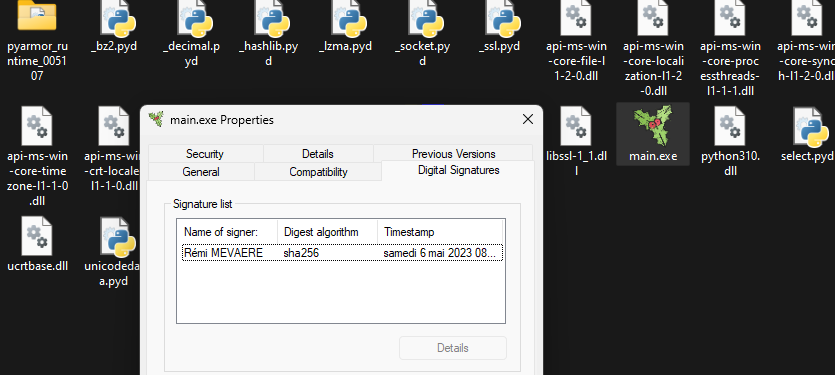
✒️ Signing extension.pyd
Advantages of signing code: - Validates code integrity - Issuing company reputation and authenticity - Safe and secure user experience - Seamless integration with multiple platforms
- On my side, I have a certificate issued by Sectigo
🛡 Building protected my_script.py
♾️ Information
- Current features of PyArmor 8+
| OS | Windows | Apple | Linux | |||||
|---|---|---|---|---|---|---|---|---|
| Arch | x86/x86_64 | x86_64 | arm64 | arm64 | x86/x86_64 | aarch64 | armv7 | armv6 |
| Themida Protection | Y | No | No | No | No | No | No | No |
| RFT Mode | Y | Y | Y | Y | Y | Y | Y | No |
| BCC Mode | Y | Y | Y | Y | Y | Y | Future | No |
| Others | Y | Y | Y | Y | Y | Y | Y | No |
| pyarmor-7 | Y | Y | Y | Y | Y | Y | Y | Y |
- PyArmor only works with the interpreter version used by your script. So be sure that the final user is using the same interpreter. One way is to pack Python with
PyInstaller.
📄 Our script
The program we want to protect is composed of two scripts. If we want to use and load our extension.pyd, we just load it like any other module.
File: main.py
from fibonacci import fibonacci

print("Welcome to the test program")
nbr = input("Please enter an integer : ")
if None != (fib_list := fibonacci(nbr)):
    print("Sequence of Fibonacci : ")
    print(fib_list)
input("Press key to stop")
File: fibonacci.py
def fibonacci(n):
    try:
        nbr = int(n)
        if nbr <= 0:
            raise ValueError

        FibArray = [0, 1]

        for i in range(nbr - 2):
            FibArray.append(FibArray[-1] + FibArray[-2])

        return FibArray

    except:
        print("Incorrect input")
        return None
📜 Obfuscating one script
First we want to protect the script fibonacci.py to see what’s happening.
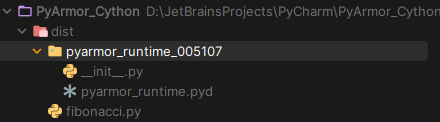
The obfuscated fibonacci.py is:
from pyarmor_runtime_005107 import __pyarmor__
__pyarmor__(__name__, __file__, b'PY005107\x00\x03\x0b\x00\xa7\r\r\n\x80\x00\x01\x00\x08\x00\x00\x00\x04\x00\x
... ... ... ... ... ... ... ... ... ... ... ... ... ... ... ... ... ...
"\xcf\x8d)mO\xfa\xe7\x04\xc8\xfeZ\xf6K\xf6,F\x14k\xbd\x07\x1e\xf5\x12\xf97=!\xb0`'")
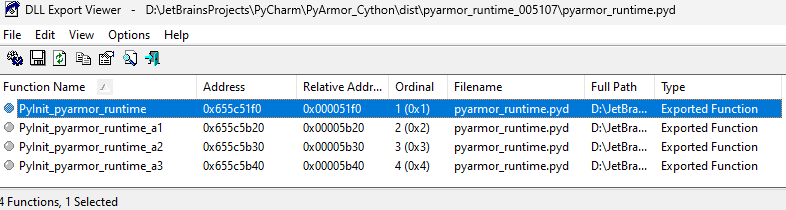
pyarmor_runtime.pyd is integrated into the dist folder. Let’s see what pyarmor_runtime.pyd contains: it is an executable from PyArmor, not open-source.
The program main.py works as expected:
(pyarmor-cython-py3.11) D:\JetBrainsProjects\PyCharm\PyArmor_Cython\dist>python main.py
Welcome to the test program
Please enter an integer : 55
Sequence of Fibonacci :
[0, 1, 1, 2, 3, 5, 8, 13, 21, 34, 55, 89, 144, 233, 377, 610, 987, 1597, 2584, 4181, 6765, 10946, 17711, 28657, 46368, 75025, 121393, 196418, 317811, 514229, 832
040, 1346269, 2178309, 3524578, 5702887, 9227465, 14930352, 24157817, 39088169, 63245986, 102334155, 165580141, 267914296, 433494437, 701408733, 1134903170, 1836311903, 2971215073, 4807526976, 7778742049, 12586269025, 20365011074, 32951280099, 53316291173, 86267571272]
Press key to stop
fibonacci.py is directly included in the PyArmor_Runtimes package.
📜 Obfuscating multiple scripts
The programmain.py will work as expected.
🥽 Protecting features
Activate the mode you desire.
--obf-module <0,1> # enable all module 1
--obf-code <0,1,2> # Obfuscation mode (best is 2)
--enable <jit,rft,bcc,themida>
--enable-jit # Use JIT to process some sensitive data to improve security
--enable-rft # renaming function/class in the scripts
--enable-bcc # converting Python functions to C functions
--enable-themida # Use Themida to protect runtime package
--mix-str # Mix the string constant in scripts
--assert-call # Assert function is obfuscated
--assert-import # Assert module is obfuscated
--period N # Check Runtime Key periodically.
🗝️Excluding Key and binding to user
In most cases, it’s better not to include the key into runtimes, but to provide it and personalize it for each user. PyArmor gives us some nice options.
‼️ Excluding Key
Change the name of the licence file
Don’t include the key
Expected behavior:> (venv) D:\JetBrainsProjects\PyCharm\PyArmorV2\dist>python main.py
> Traceback (most recent call last):
> File "D:\JetBrainsProjects\PyCharm\PyArmorV2\dist\main.py", line 2, in <module>
> from pyarmor_runtime_005107 import __pyarmor__
> File "D:\JetBrainsProjects\PyCharm\PyArmorV2\dist\pyarmor_runtime_005107\__init__.py", line 2, in <module>
> from .pyarmor_runtime import __pyarmor__
> RuntimeError: missing license key to run the script (1:10251)
🔑 Generate Key
Syntax
pyarmor gen key <options>
# Options
# -O PATH, --output PATH
# -e DATE, --expired DATE
# --period N
# -b DEV, --bind-device DEV
# --bind-data, store data
Bind device
$ pyarmor gen key -b 128.16.4.10 # IP
$ pyarmor gen key -b 52:38:6a:f2:c2:ff # MAC ADDRESS
$ pyarmor gen key -b HXS2000CN2A # SERIAL NUMBER OF DISK
$ pyarmor gen key -e 30 # 30 Days / Check NTP SERVER
$ pyarmor gen key -e .2022-12-31 # Date / Don't Check NTP SERVER (see .)
$ pyarmor gen key --period 1 # check every 1hour
$ pyarmor gen key --period 3600s # check every 1hour
$ pyarmor gen key --period 60m # check every 1hour
$ pyarmor gen key --period 1h # check every 1hour
$ pyarmor gen key --bind-data "Licensed to Rémi"
Generating a key
🔎 Get data from the key
Get hdinfo
__pyarmor__(0, None, b'hdinfo', 1) # serial n°first harddisk
__pyarmor__(1, None, b'hdinfo', 1) # mac address first card
__pyarmor__(2, None, b'hdinfo', 1) # ipv4 first card
__pyarmor__(0, "/dev/vda2", b'hdinfo', 1)
__pyarmor__(1, "eth2", b'hdinfo', 1)
__pyarmor__(0, "/0", b'hdinfo', 1) # First disk
__pyarmor__(0, "/1", b'hdinfo', 1) # Second disk
__pyarmor__(1, "*", b'hdinfo', 1) # get all network
Get keyinfo
print('bind data is', __pyarmor__(0, None, b'keyinfo', 1))
print('expired epoch is', __pyarmor__(1, None, b'keyinfo', 1))
Example
print('this is __pyarmor__', __pyarmor__) # crash if no runtimes
print(__pyarmor__(0, None, b'hdinfo', 1))
print('bind data is', __pyarmor__(0, None, b'keyinfo', 1))
print('expired epoch is', __pyarmor__(1, None, b'keyinfo', 1))
print("Welcome to the test program")
>(venv) D:\JetBrainsProjects\PyCharm\PyArmorV2\dist>python main.py
>   this is __pyarmor__ <built-in function __pyarmor__>
>   WD-WCC7K7LPJLSE
>   bind data is b'Licensed to R\xc3\xa9mi'
>   expired epoch is 1685944028
Test if protected __assert_armored__
Parameters:
- arg (object) – arg is a module or callable object
Returns:
- return arg self if arg is obfuscated, otherwise, raise protection error.
m = __import__('abc')
__assert_armored__(m)

def hello(msg):
    print(msg)

__assert_armored__(hello)
hello('abc')
📦 Packaging with PyInstaller
PyArmor absolutely needs to use the same version used when protecting the script. The easiest way to distribute the app is to pack the interpreter, the app, and the extension. Please see below how to proceed:
🩹 Generating and patching spec file
- First, we need to specify a different folder for our obfuscated files, because
distwill be used by PyInstaller. - Next, we need to move the runtime package to the current path to ask PyInstaller to include it.
- Generate the spec file for PyInstaller
- Patch
foo.specby inserting extra code aftera = Analysis.a = Analysis( ... ) # Patched by PyArmor _src = r'/path/to/src' _obf = r'/path/to/src/obfdist' _count = 0 for i in range(len(a.scripts)): if a.scripts[i][1].startswith(_src): x = a.scripts[i][1].replace(_src, _obf) if os.path.exists(x): a.scripts[i] = a.scripts[i][0], x, a.scripts[i][2] _count += 1 if _count == 0: raise RuntimeError('No obfuscated script found') for i in range(len(a.pure)): if a.pure[i][1].startswith(_src): x = a.pure[i][1].replace(_src, _obf) if os.path.exists(x): if hasattr(a.pure, '_code_cache'): with open(x) as f: a.pure._code_cache[a.pure[i][0]] = compile(f.read(), a.pure[i][1], 'exec') a.pure[i] = a.pure[i][0], x, a.pure[i][2] # Patch end. - Generate the final bundle
🗺️ Add icon
In the spec file
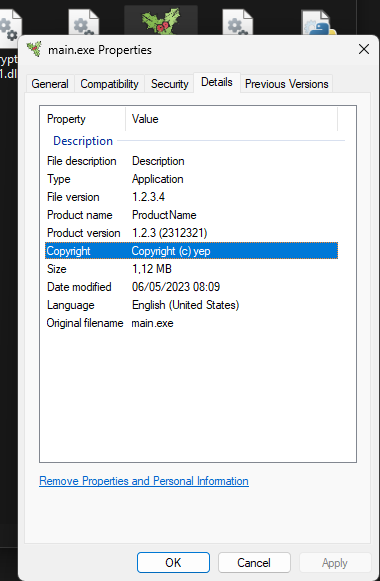
ℹ️ Adding version info
In the spec file
WithVersionInfo.rc:
VSVersionInfo(
ffi=FixedFileInfo(
filevers=(1, 2, 3, 4),
OS=0x40004,
fileType=0x1,
),
kids=[
StringFileInfo(
[
StringTable(
u'040904B0',
[StringStruct(u'CompanyName', u'Company Name'),
StringStruct(u'FileDescription', u'Description'),
StringStruct(u'InternalName', u'Internal Name !!'),
StringStruct(u'LegalCopyright', u'Copyright (c) yep'),
StringStruct(u'OriginalFilename', u'main.exe'),
StringStruct(u'ProductName', u'ProductName'),
StringStruct(u'ProductVersion', u'1.2.3 (2312321)')])
]),
VarFileInfo([VarStruct(u'Translation', [0x0409 , 0x04B0 ])])
]
)
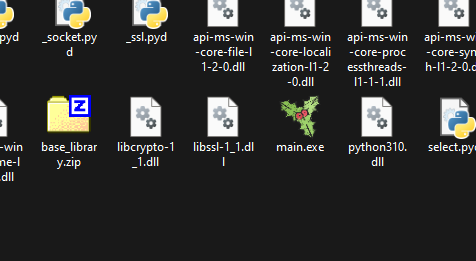
✒️ Signing the Package
- Move the license file
my_licence.key.
🌐 Conclusion
- We’ve seen how to protect our Python program, or some sensitive parts that we don't want to share.
- Each time, we have to trust an external program (not open-source).
- Even if it seems strong, with time, method, and courage, it is possible to crack your program: if the CPU can run the code, the cracker can see it.
- A better solution would be to provide the software as a service (I hate that), with more updates and a good service.
- It’s not suitable for programs that need maximum resources because using virtualization, obfuscation, and protection adds extra CPU steps and memory usage.
- This article is a good example of how to interface C++ libraries with Python.
Tip
- Rémi MEVAERE for sciences-physiques.net the 3 July 2024
- PyArmor 8.5.10, Enigma Protector X64 7.60, Python 3.12, PyInstaller 6.8